






Two recruitment firms may both place candidates, yet divide the work differently. One consultant might own the process end to end; another firm might separate account management, candidate sourcing and placement administration. A shared industry structure is useful only if you make those differences visible.
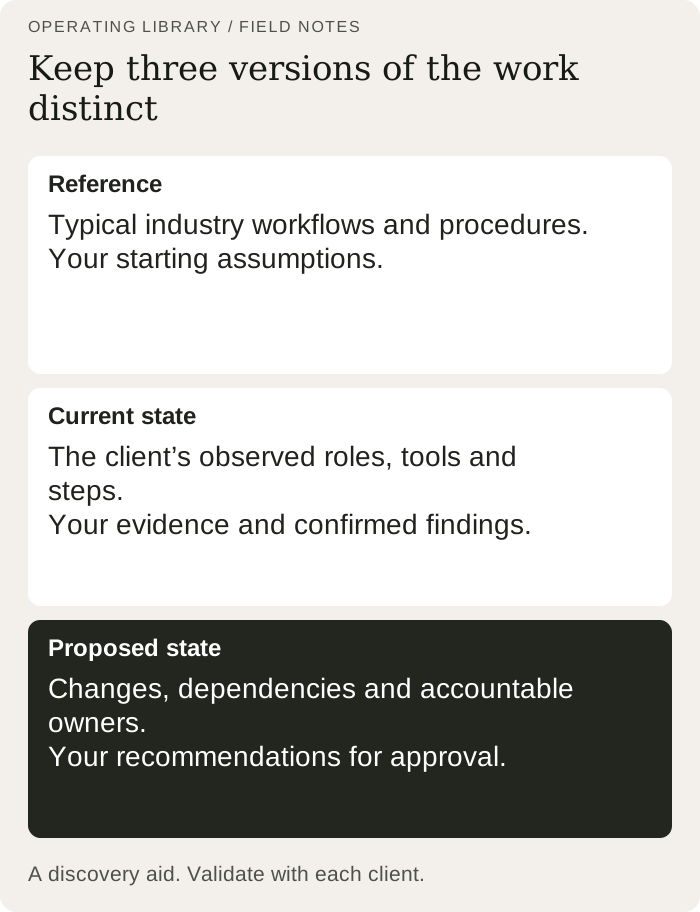
Use the reference to prepare the engagement, then build a distinct working copy for the client. The method below keeps reusable material separate from what you have actually established about the organisation.
Set up the client working copy
Keep the original edition intact. Create a client-specific copy and record the engagement scope, review date and person responsible for validating the map. Operating Library supplies editable PDFs; use a PDF editor suitable for your documentation workflow, and preserve the connection to the source procedure if you transfer material into another tool.
Choose a manageable starting point. For a recruitment engagement, that might be the workflow from an accepted job brief to an agreed sourcing plan. List the departments and roles you expect to involve, then check those assumptions with the client.
Classify each reference workflow
Give each in-scope workflow a working status:
- Applies: present in the business and ready to validate.
- Different: present, but split, combined, outsourced or run another way.
- Not applicable: outside this business model or engagement scope, with a reason.
- Missing from the reference: client-specific work to add and investigate.
These labels organise discovery. They do not certify that a procedure is accurate. An “applies” workflow still needs its actual trigger, owner, systems, steps and completion criteria checked.
Replace assumptions with evidence
In an illustrative recruitment workflow, the reference may assign brief approval to an account manager. The client may instead require the delivery lead to confirm capacity before sourcing begins. Update the owner and sequence, identify where approval is recorded and ask what happens when the brief changes.
Capture a recent example and the person who confirmed it. A useful finding might say: “Delivery lead accepts the job brief in the applicant tracking system before sourcing starts; confirmed against the reviewed placement.” If only one case has been examined, record that limit.
Keep recommendations out of the current-state map
You may recommend that an assistant draft a sourcing plan from an approved brief. That belongs in a proposed workflow with its inputs, reviewer, dependencies and acceptance criteria. Do not insert it into the map of existing operations before the client has adopted it.
At review, ask the owner to confirm the current process, identify outstanding questions and decide which proposals need further assessment. Preserve the version and date so later changes can be traced. For each change, retain the original assumption, the client-specific replacement and the evidence or decision supporting it.
Reuse the structure across engagements
The repeatable asset is the method: scope, classify, investigate, validate and version. Keep each client’s evidence and working copy separate. Reusing a reference does not require reusing another client’s confidential details.
The Recruitment Firms edition contains 204 department workflows and 750 detailed SOPs across 10 departments. Consultant licences allow adaptation for unlimited client engagements, with no user or client caps and no separate business licence required for each client.
Compare the Single-Industry and Complete Consultant licences to choose the reference coverage that fits your practice.