






Your client wants an AI roadmap. The first workshop can easily become a list of tools people have seen. Give it a more useful starting point: one business outcome and the work required to produce it.
For an AI consultant or transformation lead, an industry SOP reference is preparation for that conversation. It suggests the workflows, roles and questions to investigate. The client’s evidence determines what goes into the business map.
Choose an outcome you can follow
Start with a bounded workflow, such as taking an approved marketing proposal through to a delivery-ready client brief. Agree where it begins and ends. “Improve agency operations” is too broad for a first discovery session; “confirm what delivery needs before a new client project starts” gives the team something observable.
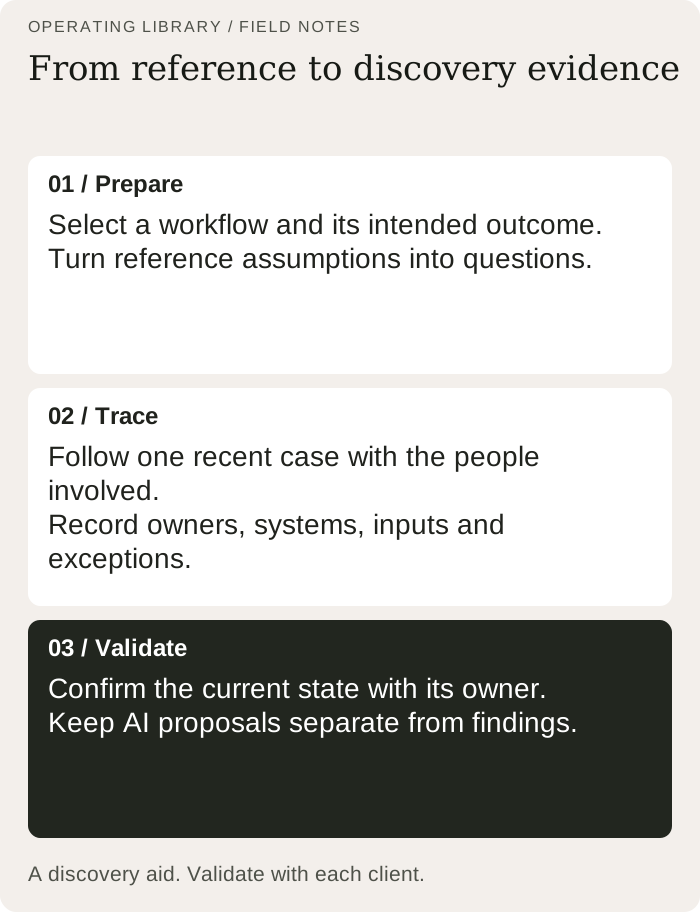
Review the relevant reference SOP before the workshop. Highlight assumptions about the trigger, owner, required inputs, software and finished work. Convert each assumption into a question rather than presenting the reference as the client’s established process.
Trace a real case, including the awkward parts
Ask the account manager and delivery lead to walk through a recent project. Use the actual brief, task record or handover message where the client permits it. Ask:
- What confirmed that the work could begin?
- Which information did delivery need, and where was it stored?
- Who checked the scope, deadline and acceptance criteria?
- What happened when the brief was incomplete?
- What showed that delivery had accepted the handover?
Record each answer with its source and an owner who can confirm it. If two people disagree, preserve the disagreement as an open question. Do not resolve it by choosing whichever answer looks closest to the reference.
Turn the difference into a discovery finding
Suppose the reference assumes an approved brief, but the team starts work from a sales email. An illustrative finding might read: “Delivery began before acceptance criteria were recorded in the project system. Confirm whether this also occurred in other recent projects.” That is more useful than immediately recommending an AI brief generator.
The next question is whether the problem is missing information, unclear ownership, an inaccessible system or unnecessary re-entry. Each points to a different intervention. AI may help with some of the work; agreeing an owner or a required field may address other parts.
Leave with a reviewable output
Use a simple finding record: reference assumption, observed practice, supporting example, owner and next question. For the brief handover, that lets you see exactly which part of the reference needs changing and who will confirm the change.
Before discussing solutions, assemble a current-state workflow with its trigger, owners, systems, steps and outcome. Attach the evidence, list unresolved exceptions and ask the workflow owner to validate it. Record candidate improvements separately, with the intended benefit and information still needed to assess them.
This gives the next workshop a defined purpose: resolve the gaps and evaluate specific changes. It also gives another consultant enough context to review your reasoning.
Prepare your next discovery session
Operating Library’s Marketing Agencies edition provides editable PDF references across 10 departments, with 204 department workflows and 794 detailed SOPs. Use the roles, triggers, steps, finished-work examples and exception guidance to prepare your questions, then adapt the material to the client.
Explore the industry SOP libraries or compare consultant licences for use across client engagements.