






A departmental map tells you where people sit. A workflow map shows how their work connects. For a consultant, the boundary between departments is often where an apparently complete procedure needs another conversation.
Take an illustrative e-commerce order. Customer support may confirm a change, while fulfilment works from the original order record. Each team can follow its own procedure and still act on different information. The discovery task is to establish what crosses that boundary and who accepts responsibility for it.
Follow one outcome through the boundary
Choose a recent order change and trace it from the customer’s request to the final fulfilment instruction. Review the source records with the relevant roles. Establish the actual sequence before proposing a cleaner one.
An industry reference helps identify likely steps and departments. It cannot tell you whether this client’s support tool synchronises with its order system, whether updates arrive in time or who is authorised to change an order after picking begins. Those are questions for the engagement.
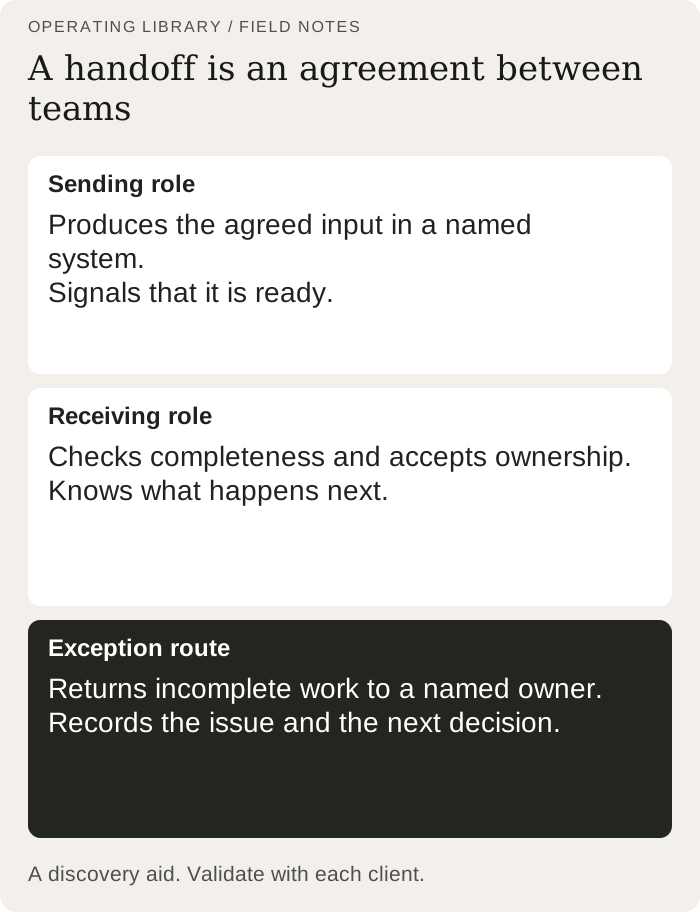
Build a handoff brief
For each boundary, record six things in a format both teams can review:
- Sender and receiver: the roles passing and accepting the work.
- Input: the information or completed artefact being transferred.
- Acceptance criteria: what must be complete and correct.
- System: where the receiving role finds the authoritative record.
- Signal: how readiness and acceptance become visible.
- Exception owner: who acts when the handoff cannot proceed.
A concrete entry could be: “Support records the approved address change against the order; fulfilment checks whether picking has started and records acceptance or routes the request to the operations lead.” Treat this as a discussion example, not a rule to impose on every business.
Map the return route
Ask what happens if the change lacks an order number, arrives after dispatch or conflicts with another instruction. Identify who can decide, where the issue is recorded and how the customer-facing team learns the outcome.
Do not label every delay as a technology problem. The missing piece may be an agreed cut-off, a visible status or a clear decision owner. Check several examples before describing a recurring pattern, and record any uncertainty.
Validate with both sides
Review the same handoff brief with the sending and receiving roles. Ask each to explain when their responsibility begins and ends. Resolve differences in the shared brief, then update the SOPs on both sides so they describe the same agreement. Ask each role to walk through an ordinary case and an incomplete-input case using that brief; gaps in the acceptance or return route become the next actions.
The output should be a current-state handoff map, a short list of unresolved decisions and separately documented improvement proposals. If an automated notification or AI assistant is proposed, name the input it relies on and the person responsible when it fails.
Prepare the cross-department conversation
Operating Library’s E-commerce edition includes 216 department workflows and 842 detailed SOPs across 10 departments. Use its roles, systems, triggers, steps and outcomes to identify the boundaries worth investigating.
Explore the industry libraries or compare licences for use with your clients.