






“Use AI in customer service” is an area of interest, not a proposal a workflow owner can evaluate. An SOP makes the discussion more specific: which step might change, what information does it require and who remains accountable for the result?
For an AI consultant or transformation lead, the useful output is a bounded candidate workflow. Establish the current process first, then describe the proposed assistance separately. An industry reference supplies prompts; the client’s evidence determines whether the opportunity is suitable.
Name a task and a measurable outcome
Consider an illustrative e-commerce support workflow: draft an order-status reply for a service agent to review. The intended improvement might be less preparation time while preserving factual accuracy and completeness. The reviewer remains responsible for sending the response.
Before choosing a target, observe the current process. Record how preparation time is measured, what counts as a complete answer and which cases require escalation. Do not attach an assumed percentage saving to the proposal.
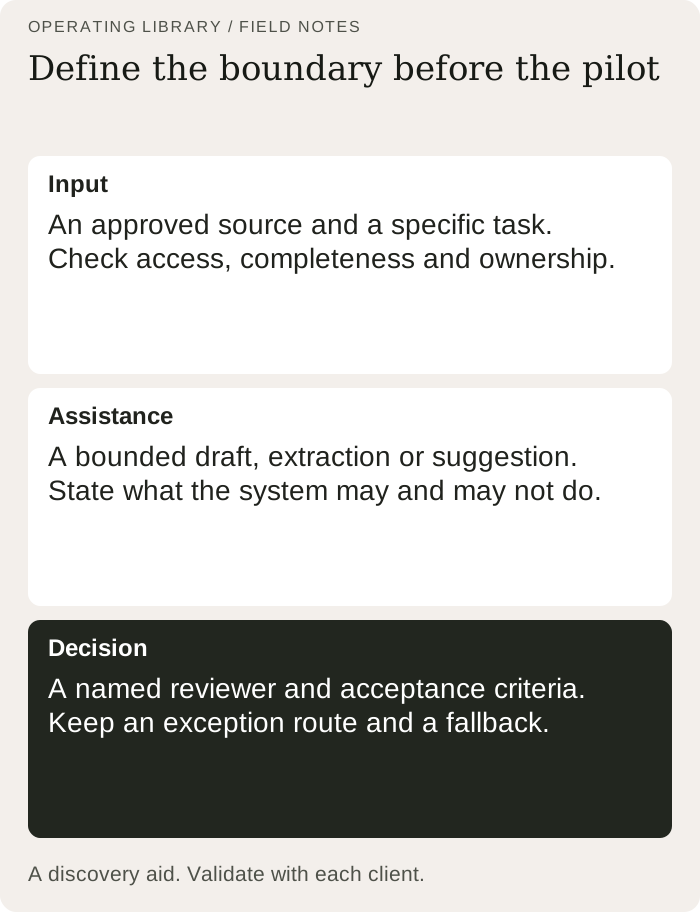
Check the source information
A reply may require the order status, an approved delivery policy and the customer’s actual question. Identify where each input comes from, who maintains it and whether the proposed workflow can access it appropriately.
An SOP naming a system does not establish that an integration exists. Record access, data quality and source ownership as dependencies to verify. If the order status is unavailable, the proposed assistant needs an explicit route back to the service agent rather than permission to infer it.
Locate the human decision
Write down what the assistance can produce and what the reviewer must check. In this example, that could mean drafting from retrieved order details and approved policy, with the service agent checking facts, relevance and tone before sending.
Requests involving an exception, conflicting records or an action outside the defined task should go to a named role. Do not quietly expand a drafting proposal into authority to change orders or make customer commitments.
Create a candidate card
- Workflow and step: where the proposed assistance sits.
- Inputs and permissions: required sources and access still to verify.
- Output: the exact draft, extraction or suggestion produced.
- Accountable owner: who reviews and accepts the result.
- Evaluation: criteria and representative cases agreed with the owner.
- Fallback: how the team continues when the assistance is unavailable or unsuitable.
Test ordinary cases and exceptions
Build a limited evaluation set with the workflow owner. Include straightforward status requests, missing information and known exception types. Compare the proposed output with the agreed acceptance criteria and the existing process. Record incorrect claims, omissions, review effort and escalation behaviour.
Agree the decision rule for proceeding before reviewing results. For the reply-drafting example, require factual statements to be supported by the retrieved record or approved policy, and require missing information to be escalated. Set any performance threshold with the owner using the observed baseline. A successful demonstration on one example is not enough to establish that the workflow is ready for operational use.
Start the assessment with the work
Operating Library’s industry editions connect department workflows with detailed SOPs, including finished-work examples, reasons for the work, and judgement and exception guidance. Each edition also includes 12 AI & Transformation workflows. Use this material to organise discovery and candidate assessment.
Explore the E-commerce reference or find the edition for your next client. Consultant licences cover adaptation across unlimited client engagements.